
Banished by Bargain:
third Country deportation watch
Monitoring the human cost of
the U.S. government’s forced
third country transfer agreements


agreements signed with at least 35 countries
+25,000 people sent to 29 countries
+$49 million in direct U.S. government funding
The Trump administration has created an opaque web of formal bilateral agreements and behind-the-scenes deals that send asylum seekers, refugees, and other immigrants—with almost no warning and little chance to raise fears of persecution or torture—to countries with which they have no ties and where many are subject to grave mistreatment including arbitrary detention or return to danger in the very countries they once fled.
The policy is one of the Trump administration’s most coercive tools to spread fear and deny protection to people who have been granted—or are seeking—safety in the United States. The agreements treat immigrants and refugees as bargaining chips, reflecting the Trump administration’s transactional and corrupt approach to foreign policy.
This tracker from Refugees International and Human Rights First shines a light on these U.S. third country transfer agreements, the political and financial motives behind them, and the harms they have caused—as well as relevant lawsuits and other efforts to challenge them.
EXPLORE AGREEMENTS BY Region and Country
Africa
Burundi | Cameroon | Cabo Verde | Central African Republic
Democratic Republic of the Congo | Equatorial Guinea | Eswatini
Ghana | Liberia | Libya | Rwanda
Sierra Leone | South Sudan | Uganda
Americas
Antigua and Barbuda | Bahamas | Belize | Costa Rica
Dominica | Dominican Republic | Ecuador | El Salvador
Grenada | Guatemala | Guyana | Honduras | Jamaica | Mexico
Panama | Paraguay | St. Kitts and Nevis | St. Lucia
Explore The Map
Tracking the Human Cost
Forced third country transfers have separated parents from children, spouses from one another, and cut people off from their communities in the United States. In many cases, they have resulted in enforced disappearances, arbitrary detention, and unlawful refoulement (where people are sent to persecution in the country they fled, either directly or via third country). Many people transferred to third countries are left in limbo and precarity: lacking legal status, identity documents, or any way to provide for their most basic needs. The toll on individuals and family members is profound: mental anguish, uncertainty, and no safe path to reunification.
Beyond those already transferred to third countries, tens of thousands of asylum seekers, refugees, and immigrants in the United States have had their court proceedings terminated or been arrested and subjected to prolonged detention because the U.S. government claims it intends to transfer them to third countries.
Methodology
Our methodology uses transparency requests, on-the-ground sources, and public reporting to determine the number of removed third-country nationals.
This tracker currently does not include forcible transfers that include a layover in a third country when the individuals transferred have removal orders to their country of origin and the third country has not agreed to process and accept them, for example, Iranians removed to Tehran via Qatar and Kuwait, Venezuelans removed to Caracas via Honduras, Russians removed to Moscow via Egypt, and Ukrainians removed to Ukraine via Poland.
Though documents have not been made public about them, the arrangement between Mexico and the United States to receive third country nationals (about 20,000 through August 2026) and arrangements between the United States and several Latin American countries to receive Mexican nationals (about 3,000 through August 2026) are included on Third Country Deportation Watch.
What types of agreements and arrangements has the United States made with third countries?
Arrangements to incarcerate forcibly transferred people in prisons in El Salvador, Eswatini, and South Sudan until eventual onward transfer.
Arrangements for temporary transfer before onward return to home country with Cameroon, Central African Republic, Democratic Republic of the Congo, Equatorial Guinea, Ghana, Panama, and Sierra Leone. In most instances, this has also included arbitrary detention.
“Asylum Cooperative Agreements” (ACA) or attempts at “safe third country agreements” (STCA) with Belize, Cabo Verde, Ecuador, Guatemala, Honduras, Liberia, Paraguay, and Uganda, where people transferred purportedly may pursue an asylum claim.
Other types of arrangements that may include detention, onward transfer, and/or remaining in the third country, such as with Mexico and Rwanda, and a new 2026 agreement with Costa Rica (following a separate 2025 agreement).
In some cases, there are multiple arragements with the same third country. Many of the countries that originally signed an asylum cooperative agreement subsequently agreed to receive forcibly transferred third country nationals from the United States outside the parameters of the ACA or pursuant to another agreement, including Guatemala, Honduras, Paraguay, Ecuador, and Liberia.
*Given the lack of sufficient tracked transfers and treatment upon arrival, the arrangements with the following countries cannot yet be categorized: Antigua and Barbuda, Bahamas, Burundi, Dominica, Grenada, Guyana, Kosovo, Moldova, Palau, St. Lucia, St. Lucia, St. Kitts and Nevis, and Uzbekistan.
Where have people been sent?
As of early September 2026, the Trump administration has used these deals to send over 25,000 third country nationals to at least 29 countries (Belize, Burundi, Cameroon, Central African Republic, Costa Rica, Democratic Republic of the Congo, Dominica, Ecuador, El Salvador, Equatorial Guinea, Eswatini, Ghana, Guatemala, Guyana, Honduras, Kosovo, Liberia, Mexico, Moldova, Palau, Panama, Paraguay, Rwanda, Sierra Leone, St. Kitts and Nevis, St. Lucia, South Sudan, Uganda and Uzbekistan).It also attempted to send people to Libya in violation of a court order.
Most third countries have received only a few dozen people or fewer, on flights without a regular cadence. The vast majority of removals of third country nationals have been to Mexico, where approximately 20,000 people have been sent since January 20, 2025, (including thousands of people that the Trump administration has not acknowledged in its accounting to a federal court). A March 2026 agreement with Costa Rica provides for regular transfers of 25 people per week. Since June 2026, one flight a month has transferred third country nationals from the United States to the Central African Republic.
The administration has also entered into agreements with at least six other countries, including Antigua and Barbuda, Bahamas, Cabo Verde, Dominican Republic, Grenada, and Jamaica, where transfers have not yet occurred as far as is publicly known. The U.S. and Uruguay are also negotiating an agreement, though, like other agreements, it has sparked opposition from politicians and civil society. The governments of the Bahamas and St. Vincent and the Grenadines initially refused to sign third country national deportation agreements with the Trump administration, but then continued to negotiate the terms of an agreement. The United States and Guinea-Bissau may be finalizing an agreement. We will update this site with country pages for these agreements when further information is available.
A separate tool, ICE Flight Monitor, tracks Immigration and Customs Enforcement (ICE) removal flights, including those to third countries, to bring transparency to government operations that are often hidden from public view.
Why is the Trump administration doing this?
The administration’s policy punishes immigrants and asylum seekers and deprives them of their rights under U.S. law. Third country deportations are a part of the administration’s racist promotion of “re-migration” and explicitly targets people in the United States determined by U.S. immigration judges to be refugees (i.e., who would be persecuted or tortured if returned to their home countries.) Third Country Deportation Watch has confirmed that the Trump administration has sent individuals determined to be refugees to Burundi, Cameroon, Central African Republic, Democratic Republic of Congo, Equatorial Guinea, Eswatini, Ghana, Liberia, Mexico, Moldova, Rwanda, Sierra Leone, St. Lucia, St. Kitts and Nevis, and Uzbekistan.
The administration is disappearing people, including people who have lived in the United States for decades, to unknown locations before family members and lawyers can help them, sending them to face arbitrary detention, torture, chain refoulement, and other harms. The mistreatment in the third country is inflicted not for any crime committed there or in the United States, but because they were immigrants in the United States subjected to a forced transfer arrangement.
The administration is wielding the threat of forced transfers to terrify immigrant communities and force people to leave the United States, including by publicly warning: “If you do not leave, we will hunt you down, arrest you, and you could end up in this El Salvadorian prison.” U.S. immigration officials also directly threaten detained immigrants with transfer to a third country in order to coerce them to relinquish their rights and abandon their immigration cases. In some cases, the U.S. government seems motivated to not only punish immigrants and terrify others, but perhaps also to pressure other governments into accepting the return of their own nationals.
The administration is using third country deportation agreements to undermine refugee protection globally and undermine adherence of governments around the world to the obligation of non-refoulement (not to return people to persecution) in the U.N. Convention on the Status of Refugees and the Convention Against Torture. The U.S. government does this by including in the agreements with third countries boilerplate language about adherence to these international treaties and provisions that people removed from the United States pursuant to these agreements will remain in third countries temporarily before repatriation. This is extremely concerning given that deported third country nationals include individuals whom U.S. immigration judges granted withholding or deferral of removal to their home countries where they would likely face persecution or torture. The agreements may continue to push other countries to violate their human rights commitments, further undermining the rule of law globally.
The administration is also using Asylum Cooperative Agreements (ACAs) to “pretermit” thousands of pending asylum cases in immigration court, refusing to consider the applicants’ asylum claims and instead issuing removal orders to third countries. This tactic is being used to automatically deny people’s asylum cases irrespective of their claim and send some to third countries, while the vast majority of asylum seekers with pretermitted cases—tens of thousands of people—are left in limbo with a removal order and facing loss of their work permit, many subject to prolonged detention or at risk of being detained, without ever having had an opportunity to present their case. Pretermissions are discussed in more detail below.
As noted above, in 2026, the United States signed new, superseding third country deportation agreements with many of the same countries with which it initially signed ACAs, further indicating that the ACAs were simply a pretext to throw asylum cases out of immigration court.
Who is being sent to third countries through these deals?
The Trump administration has used these deals to banish to third countries men, women, children, and families, including pregnant people, individuals with medical or psychological vulnerabilities, and those with recognized legal protection claims. People who have been forcibly transferred from the United States under these arrangements have come from a wide range of countries across the globe. This tracker’s country pages specify the nationalities and number of people sent to each third country.
The administration has forcibly transferred asylum seekers and other migrants at various stages of their immigration case, including:
people arriving in the United States to seek asylum who are expelled without consideration of their claim
people in the midst of their immigration court case who have not received a full hearing on their asylum claim or a decision from a judge
people to whom U.S. immigration judges have granted protection under the Convention Against Torture (CAT) or withholding of removal because of likely torture or persecution in their home countries. This includes people who have pending habeas corpus claims in U.S. courts, those who had already secured their release through habeas litigation but were re-detained by ICE, and people who would have been granted asylum but were not because of an unlawful regulation that has been struck down by a federal court
people with final orders of removal for whom removal to the third country was never raised by the government
Why would other countries agree?
Through forced third country transfer agreements, the Trump administration has warped U.S. international relations in service of its deportation agenda. In many cases, the reasons countries have agreed to receive third country nationals remain murky, often bound up in pressure and incentives from the Trump administration, as well as broader bilateral geopolitical and financial interests.At the time that many of these agreements were signed and implemented, the Trump administration imposed or threatened third countries with visa bans, deportation of their own nationals, tariffs, and other trade barriers, as detailed in the country sections. The Trump administration also has provided funding to some of the third countries, including for migration and border enforcement, defense, and condoned corruption, repression, and violations of human rights by governments in third countries.
Third Country Deportation Watch has tracked that the U.S. government has paid at least $49 million to third country governments in direct connection with the agreements (which does not include the costs of flights).
Other U.S. incentives are more indirect. Some deals seem to be tied to U.S. investment in mining or other sectors or support for public health or other aid, albeit more restricted and limited than the United States provided in the past given massive U.S. cuts in humanitarian aid since January 2025. The administration has also diverted State Department funding formerly devoted to support and services for refugees abroad to these deportation agreements. Indeed, the administration has made funding available to the UN Refugee Agency and the International Organization for Migration in countries with existing agreements so that they can work with immigrants, refugees, and asylum seekers forcefully transferred there by the United States.
Is it legal?
The administration has used a range of tactics to attempt to justify these transfers, some in unprecedented ways. With respect to some of the transfers, the Trump administration has unlawfully invoked Constitutional authority to respond to an “invasion” and a centuries-old wartime law (the Alien Enemies Act, 50 U.S.C. §§ 21-24), casting people seeking safety as a threat. It has also unlawfully invoked other statutory provisions such as one regarding “suspension of entry” (8 U.S.C. § 1182(f)) for certain noncitizens, which was enacted long before codification of the Refugee Convention and its Protocol, and others addressing safe third country agreements (8 U.S.C. § 1158(a)(2)(A)) and countries to which people with final orders of removal may be removed (8 U.S.C. § 1231(b)). Legal services organizations and immigrants have challenged the forced third country transfers in U.S. courts. Federal judges have already held them to be unlawful in several cases, including with respect to expulsions of Venezuelans to El Salvador under the Alien Enemies Act, expulsions of asylum seekers under a Presidential Proclamation shutting down asylum access at the southern border, and forced transfers of people with final orders of removal—including those granted humanitarian protections—without notice or opportunity to raise a fear claim about the third country. Additional legal challenges include ongoing litigation against the Administration’s Asylum Cooperative Agreements (ACAs), which have led to the forcible transfer of asylum seekers to countries that are not safe and where they cannot access asylum. Attorneys also have had some success opposing the government’s efforts to pretermit asylum cases under ACAs and successfully challenged forced third country transfers through habeas corpus petitions. Additional guidance for attorneys is included in the resources page of this site.
In some cases, the Trump administration has carried out forced transfers in direct violation of court orders in effect at the time. It has also appealed court orders—leading to a temporary stay of some decisions—and continued to forcibly transfer people to harm in third countries while litigation is ongoing. The Trump administration has targeted for removal third countries people denied asylum (and granted withholding of removal based on strong refugee claims) only because of a Biden era “circumvention of lawful pathways” regulation ruled unlawful by a federal court. It has also removed to third countries people with pending habeas corpus claims. Further, the Trump administration has re-arrested and removed to third countries people who had been granted withholding of removal by an immigration judge and released from detention after prevailing on a habeas claim challenging the legality of their detention.
Lawyers and members of civil society in third countries have brought challenges in their courts and international and regional bodies regarding their governments’ treatment—including detention, refoulement, and other human rights violations—of those transferred by the United States to their counties. Politicians in third countries have demanded more transparency regarding the agreements and other governments have at times refused to sign third country agreements and denied requests for transfers from the Trump administration.
Members of the U.S. Congress and international bodies have condemned the unlawfulness of forced transfers and the lack of transparency around the agreements.
How is the administration using Asylum Cooperative Agreements to pretermit cases in immigration court?
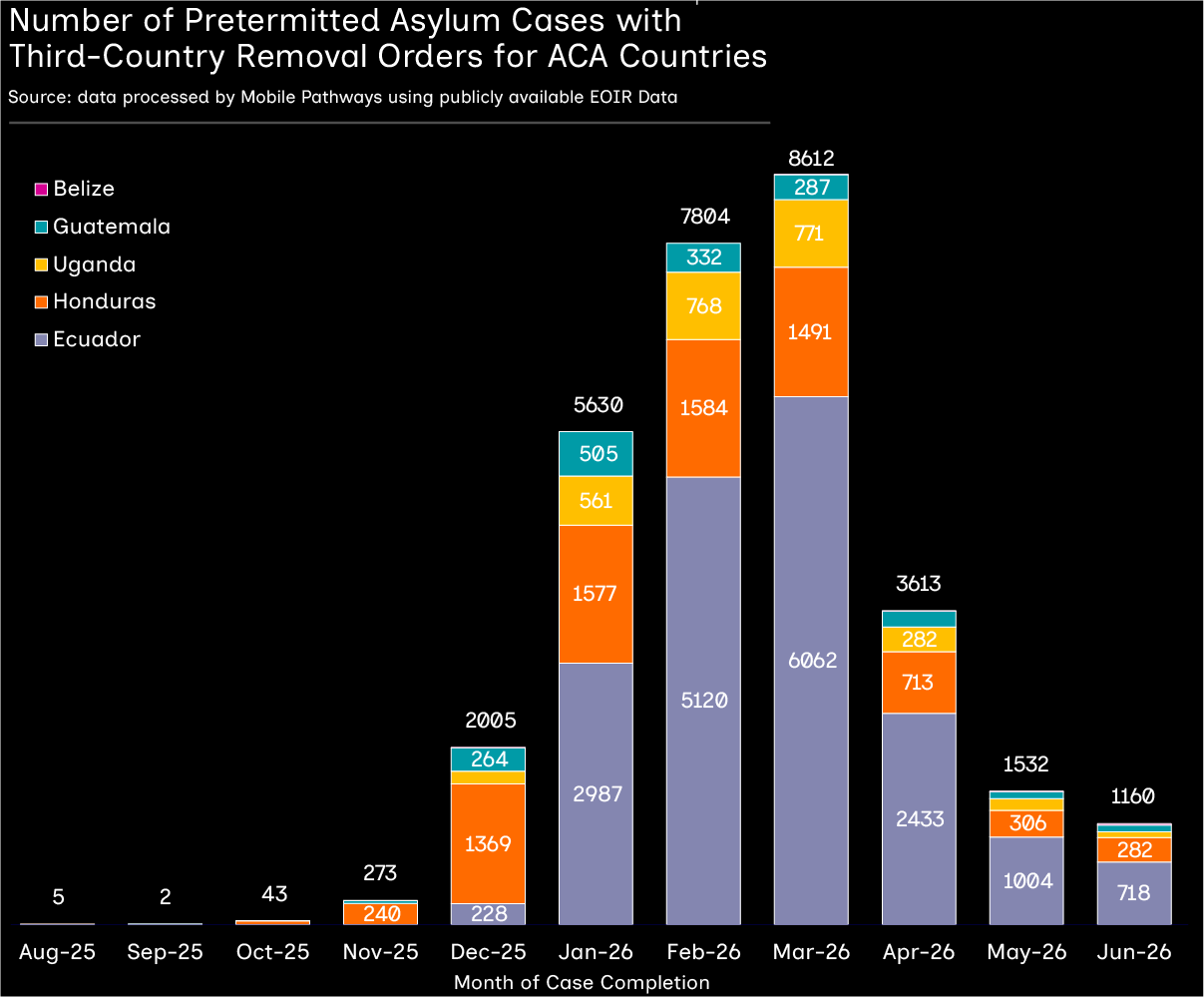
In the second half of 2025 and the first half of 2026, attorneys for ICE filed motions in immigration court to pretermit asylum applications pursuant to Asylum Cooperative Agreements with multiple third countries, making it extremely difficult for an asylum seeker to contest the motion and make a case against removal to those countries, particularly if unrepresented. On March 13, 2026, DHS directed ICE attorneys to halt filing new motions to pretermit asylum claims per the ACAs—but not to withdraw motions that were already pending. ICE attorneys continue to argue in support of pretermission motions and judges continue to pretermit cases, thus refusing to consider them on the merits, and to order asylum seekers removed to ACA countries.
The organization Mobile Pathways used publicly available Executive Office of Immigration Review data to track 32,448 pretermissions of individual asylum cases with an Asylum Cooperative Agreement country (Belize, Ecuador, Guatemala, Honduras, or Uganda) listed as the first country of removal for non-nationals of those countries through August 2026. As of August 2026, Third Country Deportation Watch estimates that between 200 and 300 third country nationals have been removed under the Asylum Cooperative Agreements: over 121 to Ecuador, over 100 to Honduras, 8 to Uganda, and 8 to Belize; it is unclear if or how many transfers of third country nationals to Guatemala have been done pursuant to the ACA. Given the large discrepancy between granted pretermissions and actual deportations pursuant to the ACAs, pretermissions seem aimed to throw out from immigration court large numbers of asylum cases without consideration of the persecution or torture people fear, coerce people in need of protection to abandon their claims rather than face an order of removal to a third country, deter people from seeking protection in the United States, and put vulnerable people at risk of harm in U.S. detention or through removal to a third country.
What are Forced third country transfers?
We are using this term to describe the deportation or expulsion of individuals from the United States to third countries where they are not citizens and to which they are forcibly sent, often exposing them to harm or the risk of chain refoulement. These transfers occur through various bilateral agreements and arrangements between the United States and other governments.
What are Enforced Disappearances?
The arrest, detention, abduction, or other deprivation of a person’s liberty by state agents—or by others with the state’s approval, support, or acquiescence—followed by a refusal to acknowledge the detention or by hiding the person’s fate or whereabouts. This places the person outside the protection of the law.
What is arbitrary detention?
Arbitrary detention is the deprivation of liberty that lacks a legal basis, such as conviction for a crime, or, even when tethered to a cause and authorized by law, is unreasonable or disproportionate and carried out without due process. Detention is considered arbitrary when individuals are detained without relation to their own actions, not promptly informed of the reasons for their detention, are denied access to judicial review or the ability to challenge its lawfulness, are held for prolonged or indefinite periods, or are detained in a discriminatory manner. Even where domestic law permits detention, it may still be arbitrary if it is unnecessary or lacks justification or adequate procedural safeguards.